Pop-Up Story / College Football History · Game Day · 13 min read
The Forgotten Truth About the Land Grant Trophy
College football fans have marveled at the Penn State-Michigan State trophy for more than 30 years. But along the way, they forgot about the Piqua, Ohio, company and workers who actually built it.
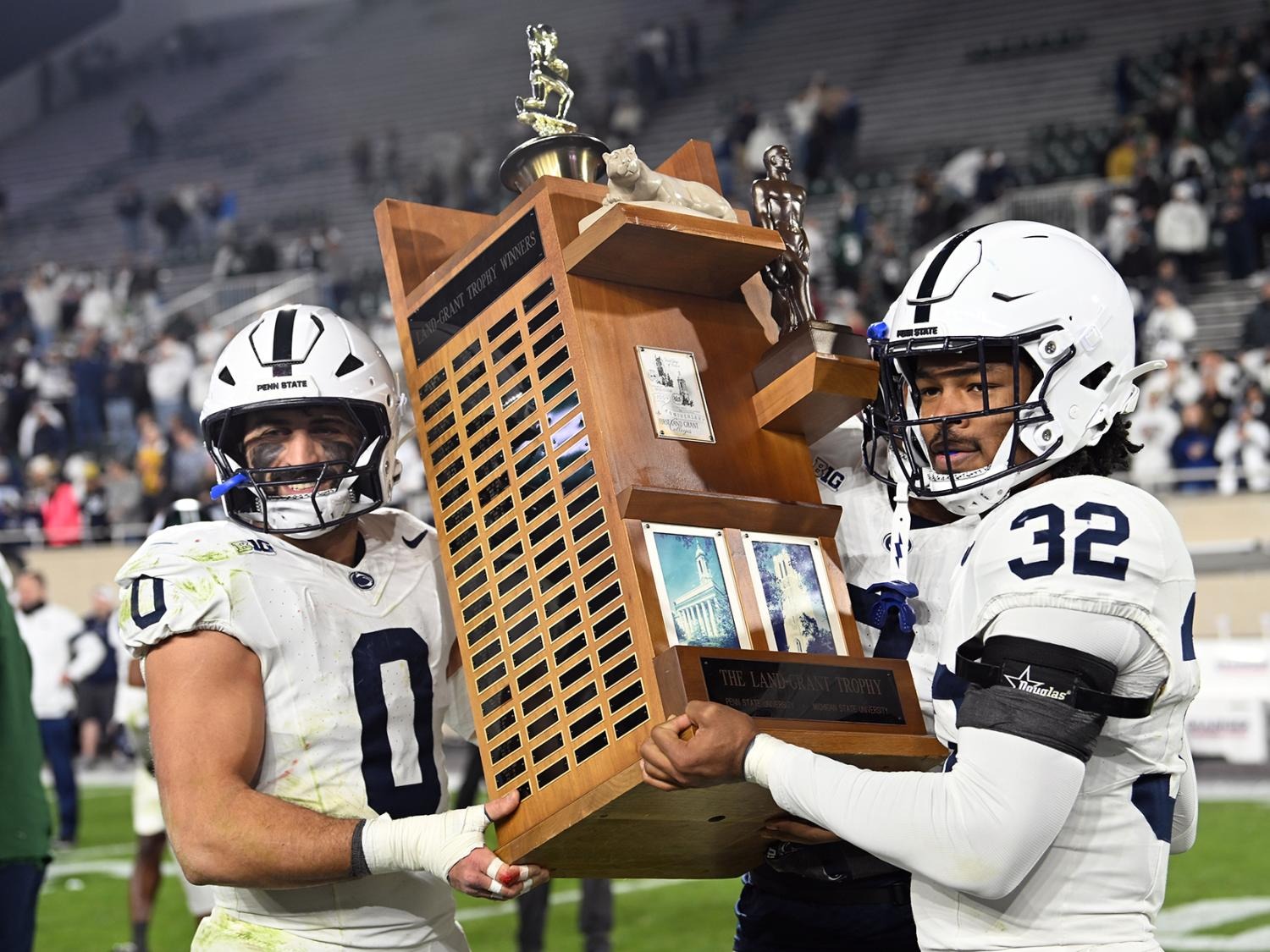
The beauty of the Land Grant Trophy is in the eye of the beholder.
But remember, Shrek was a hideous beast to everyone except Princess Fiona.
The four-foot-tall wooden creation awarded to the winner of the Penn State-Michigan State football game has been compared to everything from a middle school shop project to a piece of furniture someone forgot to finish. It has pictures, statues, shelves and enough solid walnut to make an Amish furniture maker jealous.
And college football fans love it.
Former Penn State quarterback Sean Clifford once called it “the prettiest block of wood I've ever seen in my life.”
But this story isn't really about whether the Land Grant Trophy is aesthetically pleasing. It's about who built it because, somewhere over the past three decades, that part of the story mostly disappeared.
I never would have known about it if my lifelong friend John Hannon hadn't attended the Northern Iowa vs. Iowa football game in September with his brother-in-law.
A Conversation in the Stands
John was at the game with his wife, Bridget, Bridget's sister Josie and Josie's husband, Mike Elrod. John loves the traditions surrounding college football, including the bands, stadiums, rivalries, fight songs, waves to ill children (an Iowa staple), and weird trophies passed back and forth between schools for decades.
Somewhere during the game, John mentioned that fascination to Mike, who responded with a family story.
His father, Bob Elrod, owned the business that created what Mike jokingly called “the ugliest trophy in college football.”
That got John's attention because it was the Land Grant Trophy.
You have to know John to understand his incredibly inquisitive nature. He pulled out his phone and began searching right there in the stands among nearly 70,000 other people. There was plenty of information about the trophy, including stories about Penn State and Michigan State, the origins of the rivalry, and former Michigan State coach George Perles and Penn State coach Joe Paterno.
But John couldn't find Bob Elrod, which seemed strange.
John didn’t question Mike’s integrity. But he did wonder aloud why Bob wasn’t mentioned in any of the stories he researched.
So, Mike did what most sons would do when someone couldn't verify a story involving their father. He contacted Dad.
Again, all of this was happening while they were sitting in the stands at Kinnick Stadium.
John asked questions while Mike texted back and forth with Bob, who confirmed the basic story. His company, Tempo Manufacturing in Piqua, Ohio, had built the Land Grant Trophy.
And unlike many family stories that grow better with every retelling, Bob had receipts.
He texted John a photograph of an old newspaper article, then sent him a picture of a handwritten letter dated December 8, 1993.
John immediately knew there was something here, what he later referred to as “a Paul Harvey The Rest of the Story thing.”
He recently retired after spending decades in leadership in the television broadcast industry, where accuracy matters and details can't simply be assumed. If an Ohio company and its employees built one of the most recognizable trophies in college football, John believed they should be part of its history.
That's when he called me and patiently hammered away at my confusion about his excitement until I finally understood what he was telling me.
Penn State Begins Big Ten Play
To understand how a trophy created for Penn State and Michigan State ended up being built in Piqua, Ohio, we have to go back to 1993.
Penn State was beginning Big Ten football competition, and the Nittany Lions and Spartans were natural choices to play one another at the end of the season because of a shared piece of history. Michigan State was founded on February 12, 1855, and Penn State followed 10 days later. Both schools grew from agricultural roots and eventually became prominent land-grant universities under the Morrill Act of 1862.
Since this is college football, somebody naturally decided they needed a trophy.
Actually, several somebodies were involved.
Michigan State coach George Perles later wrote that he and Penn State coach Joe Paterno came up with the trophy game together. Perles credited Michigan State ticket manager Don Loding with developing the concept and sports information director Ken Hoffman with supplying the Land Grant name, a nod to the schools’ shared land-grant heritage.
A newspaper article published in Ohio in 1993 went even further, crediting Hoffman with both naming and designing the trophy. Later accounts have often credited Perles with designing it, but the contemporary Piqua article specifically identified Hoffman as the designer.
Then somebody had to actually build the thing, which is where Larry Cushion entered the story.
Cushion owned Larry Cushion Trophies and Engraving in Lansing and had done work for Michigan State for several years. He also had a connection named Bob Elrod.
“When I bought the business in Piqua, he became one of my customers,” Bob said. “After he passed away, his daughter took over and was a customer.”
According to the 1993 newspaper story, Cushion contacted Elrod approximately two weeks before the Penn State-Michigan State game.
Bob remembers the conversation more simply.
“Larry Cushion contacted me and said the schools had gotten together to make the trophy and they needed a source, and I was the source,” he recalled, meaning they needed a manufacturer.
Cushion sent him a drawing of what the schools wanted.
Bob handed it to his employees and they went to work.
Made From Scratch in Piqua
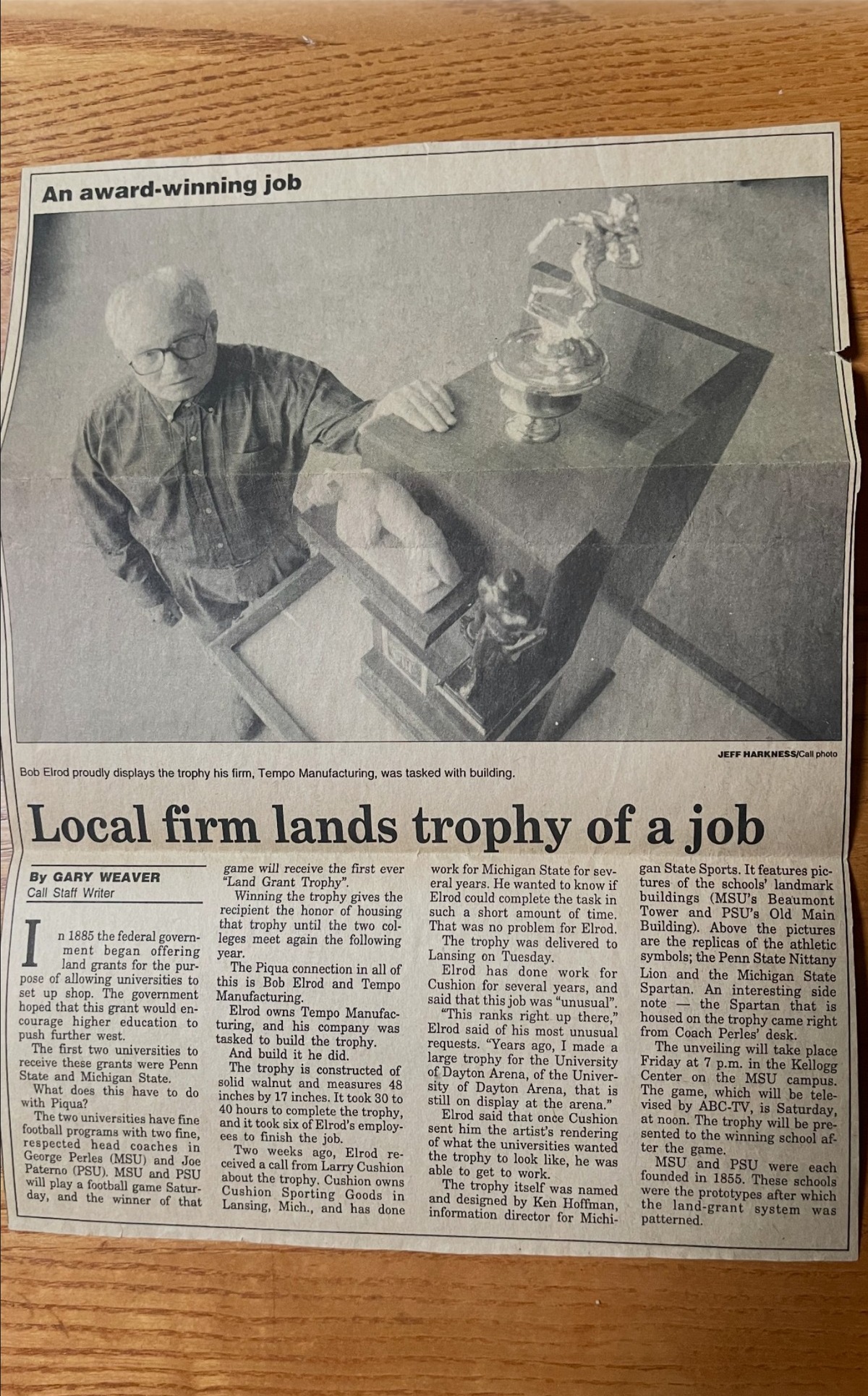
The newspaper clipping Bob saved all these years appeared under the headline:
“Local Firm Lands Trophy of a Job.”
Gary Weaver wrote the story, and the accompanying photograph shows Elrod standing beside the newly constructed trophy.
The caption reads: “Bob Elrod proudly displays the trophy his firm, Tempo Manufacturing, was tasked with building.”
Bob is quick to make an important distinction more than three decades later.
“I didn't personally make it,” he said. “I owned the company that made it. I gave my people the drawing of what they wanted and they made it.”
The old newspaper story reported that six Tempo employees worked on the trophy. Bob can still remember several of them.
“The supervisor was Clifford Smith. His brother Danny Smith also worked there. My brother, Dick, worked there. A guy who did some of the finishing work was Bobby Maxon,” he said, spelling out Maxon’s last name.
Those names may be among the most important pieces of information to emerge from this story because Bob said none of the men who actually built the trophy are still alive.
“The guys that made it are no longer around,” he said. “They've all died.”
For more than three decades, millions of college football fans have seen their work without knowing their names.
The trophy was made from solid walnut, measured approximately 48 inches tall and 17 inches wide, and reportedly required between 30 and 40 hours of work.
Bob remembers the process beginning much more basically than the finished trophy might suggest.
“The trophy is solid walnut. It was a big job. We started with raw wood. They told us what they wanted and we gave it to them,” he said.
He doesn't remember the exact appearance of Cushion's original drawing but believes it had to contain enough detail to establish the dimensions.
“It had to be some kind of hand drawing to get the dimensions and everything,” he said. “It was made from scratch.”
And from that simple description, one of college football's strangest trophies came to life.
A drawing arrived in Piqua. A group of Ohio craftsmen started with raw walnut and built a trophy that remains nearly one-third of a century later.
The Coaches Added Their Own Touches
The trophy had to represent both schools, which explains why it looks like somebody kept adding things until they ran out of room.
Penn State's Old Main is there, along with Michigan State's Beaumont Tower and representations of the Nittany Lion and Spartan.
Bob said the basic trophy his employees built followed the drawing provided by Cushion almost exactly.
“It was exactly as they designed, except adding the things from the coaches' desks,” he said, noting both coaches contributed a personal item.
“Each coach had something on his desk that they wanted added to the trophy,” he noted.
The 1993 newspaper article specifically reported that the Spartan figure came from Perles' desk.
That means the trophy wasn't simply constructed from plans. A piece of both coaches' offices became part of the finished product.
Imagine being one of the guys at Tempo.
Here's the drawing. Here's the walnut. Here are the pictures. And the coaches sent some stuff from their desks.
Find somewhere to put them.
One More Problem: Getting It to Lansing
After building a four-foot trophy out of solid walnut, Tempo encountered another problem.
How do you ship it?
That was actually Bob's first reaction when he saw what he agreed to have his company build.
“I thought, boy, how are we going to get that thing there?” he laughed.
“There” was Cushion's business in Lansing.
“UPS wouldn't take it. It was too big.”
Bob believes his brother Dick drove the trophy to Toledo and transferred it to Cushion, who then took it to Michigan State, although he is careful not to state something as fact that he can't clearly remember nearly 33 years later.
However it was transported, the trophy made it to its destination.
Bob’s answer says as much about him as it does about the trophy. When he remembers something, he says so. When he doesn't, he doesn't pretend.
“They Are Still Raving About It”
The 1993 newspaper clipping is enough to establish Tempo Manufacturing's role in building the trophy, but Bob has something even better.
The letter came from Larry Cushion and is dated December 8, 1993, less than two weeks after Penn State and Michigan State played the first football game for the Land Grant Trophy.
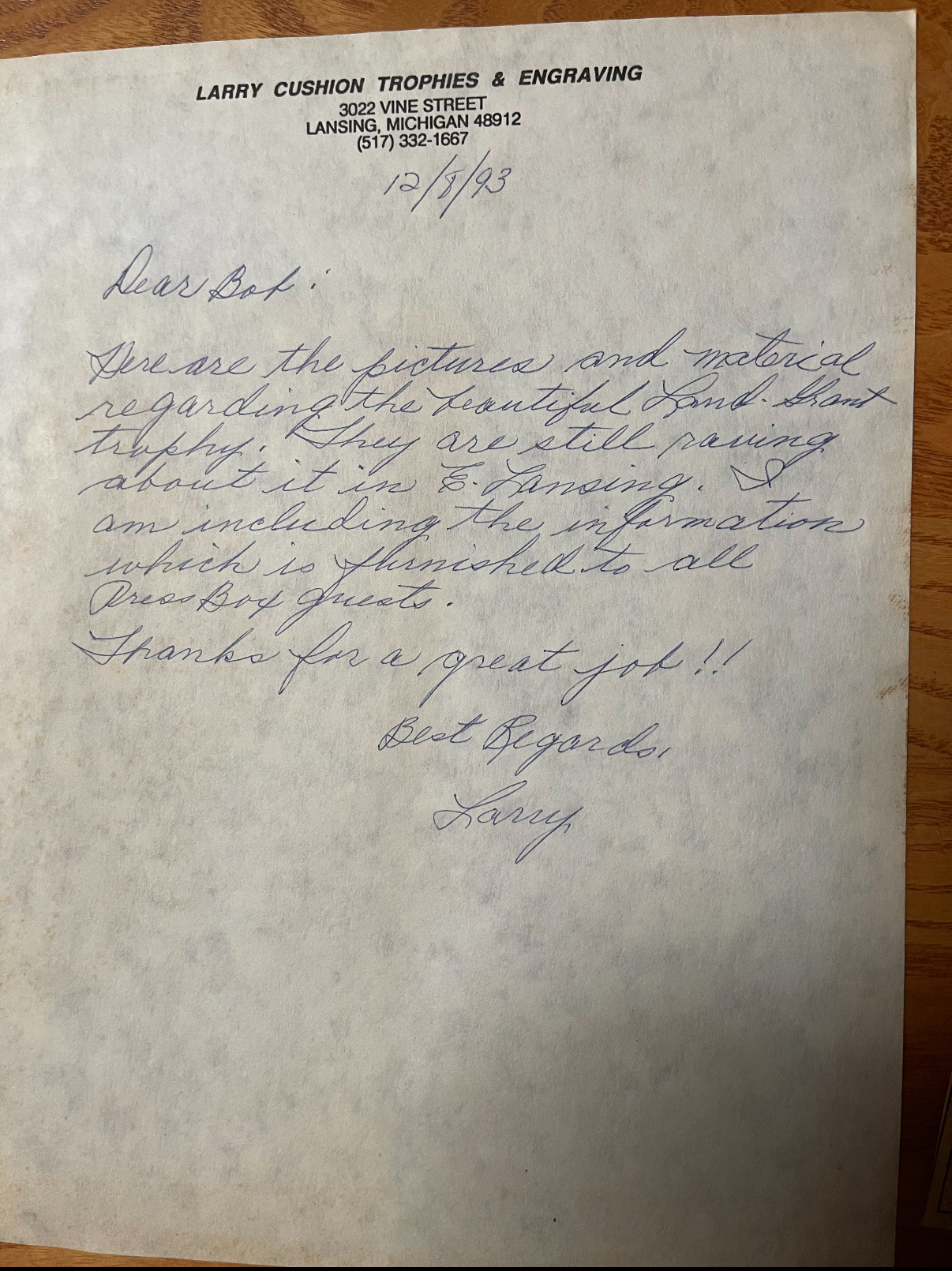
Cushion addressed it simply, “Dear Bob,” and told Elrod he was sending pictures and material about the trophy.
Then he added an interesting sentence:
“They are still raving about it in E. Lansing.”
At the bottom he wrote:
“Thanks for a great job!!”
The letter has spent more than three decades tucked away in Bob Elrod's possessions.
He never thought much about it, but that hand-written letter from Cushion to him connected history dots that have been overlooked for decades.
Combined with the contemporary newspaper article, Cushion’s handwritten letter provides strong evidence that Tempo Manufacturing built the trophy and that the history we know of the Land Grant Trophy, while accurate in many regards, is still incomplete.
Bob kept the letter and newspaper clipping with the thought of giving them to Larry Cushion’s family.
Now they are staying in the Elrod family.
“I saved the article and the Larry Cushion letter and was going to send them to Larry's daughter, but my son wants it, so I'm going to give it to him,” he said.
Which is a great idea since that letter is part of college football history.
So Who Created the Land Grant Trophy?
This is where wording becomes important.
Mike told John his father created the ugliest trophy in college football, which is true because his dad’s company made it. But Bob himself is more precise.
He didn't design the trophy, nor did he personally construct it.
He owned the company that did.
Paterno and Perles were involved in establishing the trophy game. Loding has been credited with developing the concept. Hoffman came up with the Land Grant name and was identified in the contemporary newspaper article as its designer. Cushion took the plans to the Piqua company capable of turning them into something real.
Then Clifford Smith, Danny Smith, Dick Elrod, Bobby Maxon and other Tempo Manufacturing employees took raw walnut and a drawing and produced the actual trophy.
Bob provided the company, equipment, and people capable of doing the job. His employees provided the hands and skills that made the Land Grant Trophy real.
But over time, their work was forgotten.
Eventually, the Piqua part of the story also disappeared.
But the trophy they built sure didn’t.
Penn State Took It Home
Penn State and Michigan State played on November 27, 1993.
Hopefully somebody at Michigan State appreciated the trophy during the few days it was there because Penn State immediately took it, winning a thriller, 38-37, and kept it until 1997.
Imagine rushing to get this giant trophy completed, figuring out how to transport something UPS wouldn't mess with, getting it delivered to your stadium in Lansing, and then watching the visiting team carry it home.
Or maybe Michigan State staffers got a kick out of watching their counterparts at Penn State trying to figure out how to move the trophy equivalent of a baby grand piano.
The trophy bounced between the schools in the years that followed, mostly to Penn State until 2010. The rivalry never became Ohio State-Michigan and never developed that kind of hatred, but the trophy developed a personality bigger than the rivalry itself.
That’s a testament to the awesomeness of college football traditions.
We sing the same songs our grandparents sang, rub statues for luck, jump into lakes, dot letters with sousaphones and give enormous wooden turtles to game winners. When somebody constructs a four-foot-tall walnut trophy with buildings and statues attached to it, we spend the next three decades arguing about whether it's beautiful or hideous.
Bob Didn't Need the Credit
When I first started looking into this story, I wondered how Bob felt about his company's role largely disappearing from the history of the Land Grant Trophy.
Maybe he felt frustrated, cheated, or spent years wondering why nobody credits his company in Piqua for building it.
Nope.
“I never felt anybody owed me anything,” he said. “I just thought it was nice. Remember, I've been away from that business for over twenty years,” he laughed.
John told me before I called Bob that he didn’t care about credit, and he was right.
Bob didn’t run around telling people his company built the Land Grant Trophy. He still doesn’t unless it happens to surface in conversation among friends. “Maybe over a beer if the subject comes up,” he said.
He had a business to run and life moved on.
Penn State kept playing Michigan State, the trophy became famous, the internet arrived and stories were written about its history.
Many of those stories left him and his company out. But Bob really doesn’t seem to care.
He simply kept the article and letter. “I’m not a computer or cell phone guy,” he laughed, which helps explain why he is largely unaware of information online.
Then, more than three decades later, his son happened to be sitting beside John Hannon at an Iowa football game.
John mentioned how much he enjoyed college football traditions. Mike mentioned his dad. John searched and found nothing. Mike called Bob.
“When Mike called saying John wasn't sure about the story, I thought, ‘Where's that article and letter?’” he laughed.
Bob found them and sent them to Mike, who shared them with John. John called me, gifting me a story about a historical omission.
I called Bob.
And an almost forgotten part of college football history started coming back to life.
Still Going at 89
Bob Elrod is now 89.
He hasn't spent much time sitting around reminiscing about old trophies.
“I work out three times a week. I play golf three days a week. And I work at the golf course on Saturday and Sunday mornings,” he told me, adding with a chuckle, “That’s how I play free golf.”
He's been doing some version of that for 20 years, which is another reason he never worried about getting credit for something his company did back in 1993.
He's been too busy enjoying retirement.
The men who actually transformed the raw walnut into the Land Grant Trophy aren't here anymore and can't tell us what they thought when that strange drawing arrived at Tempo Manufacturing.
They can't describe the conversations in the shop or explain how they figured out how to build it, but their work lives on.
Every time Penn State and Michigan State play for the Land Grant Trophy, those guys from Piqua are part of the game whether anybody realizes it or not.
College football history usually belongs to the coaches who won the games and the players who lifted the trophies. But those aren't the only people who create traditions.
Somebody organizes the tailgate parties, decides to cross out every M in the city, and suggests recognizing children in a nearby hospital. And somebody builds the trophies.
In November 1993, a group of guys in Piqua, Ohio, started with raw walnut and somebody else's drawing.
They built something people have been curious about ever since, something that lasted.
More than three decades later, the Land Grant Trophy is still being carried off football fields, shown on national television and debated by fans who can't decide whether it's beautifully ugly or just ugly.
Bob Elrod doesn't seem too worried about which side wins that argument.
His company got a job and his people built it. Larry Cushion thanked them for doing a great job. And nearly 33 years later, it’s still here.
Incidentally, Bob is a huge Ohio State Buckeyes fan.
I don’t know if he appreciates that irony, but I do.
It took the craftsmanship of Buckeyes to create a trophy shared between fellow Big Ten schools, including one that resides in Xichigan.
O – H!