Whatever Happened To...? / Walk-On Story · Recovery · 7 min read
Marcus Williams: Don’t Ever Give Up
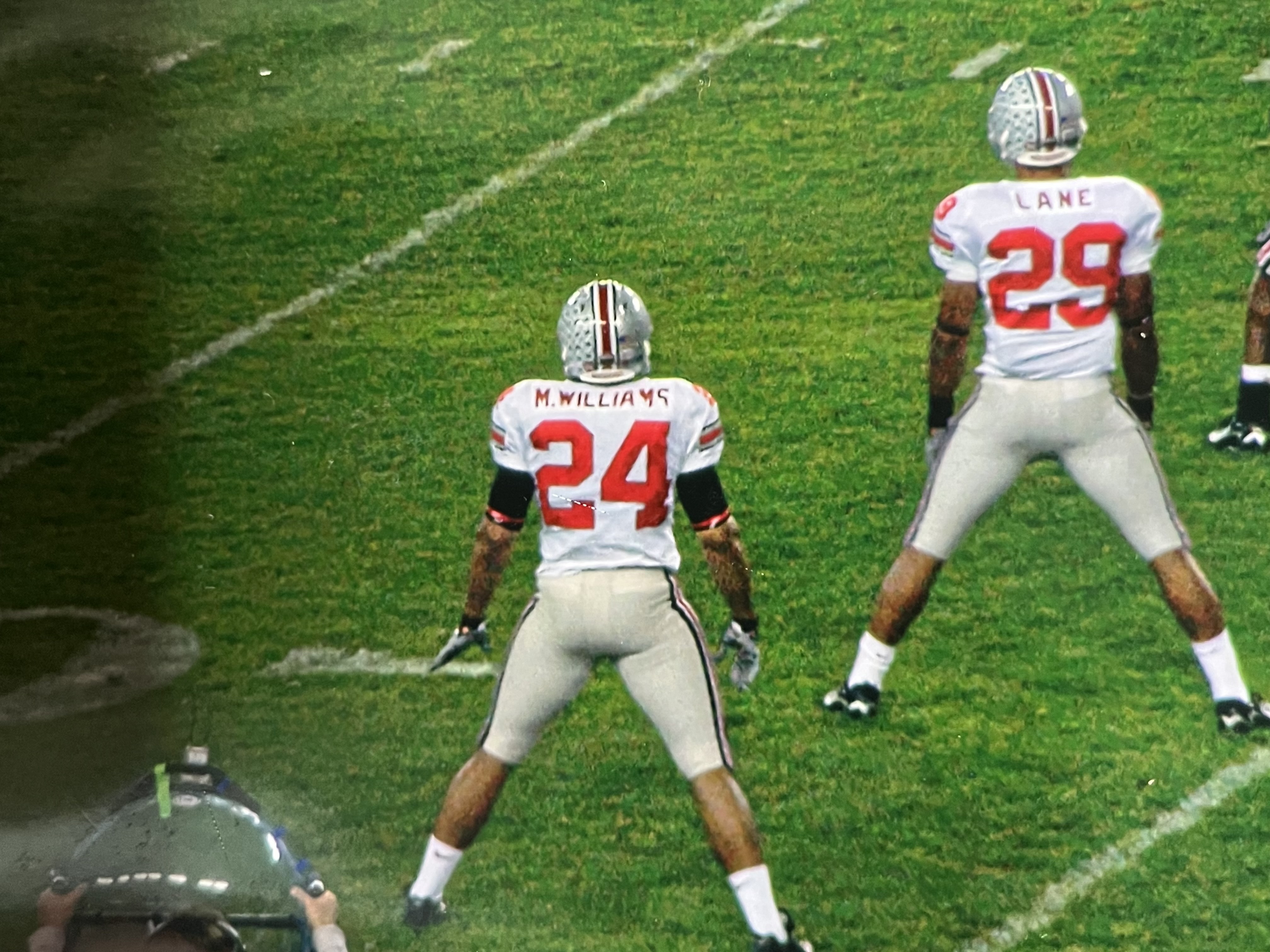
Ironton walk-on Marcus Williams earned a starting role at Ohio State, carried Shane Jones’ example with him and built a life of service after football.
I started writing local stories as a hobby in 2006. My first printed story was about Shane Jones, a local teenager whose battle with leukemia captivated the entire Ironton community in 2002. Shane’s life dramatically changed mine, making him a very easy topic to cover.
After that, I struggled for a few weeks deciding on content for future stories. What do I write about next? What else am I passionate about? What would be interesting to others? Then, like manna from Heaven, Tyler Whaley returned a phone call and my hobby took off. His unorthodox ride to the top of the Ohio State depth chart provided weekly story information. He took questions on elaborate, descriptive rides that filled notebook pages. Usually, it was me who had to end the call. He was an interviewer’s dream.
I remember thinking, “This is easy.” I’d found a niche covering a member of the Buckeyes football team. My dreams came true covering Tyler’s dreams.
Marcus Williams also played at Ohio State at the time. Just like Tyler, he was also a standout Ironton Tiger and walk-on to the Buckeyes football team. He also agreed to an interview. But the similarities quickly faded. Marcus held his cards close to his vest. Questions were met with brief responses. Little elaboration. No wild page-scribbling details. He was a young man of few words and I was a middle-aged man in dire need of Socratic questioning skills!
Then the email happened. At some point, Marcus and I agreed to me emailing him questions. He would respond when he had time, and with much more detail than in phone interviews. One of the questions I sent him was, “Who is your hero?” I’ll never forget the electrical jolt that shot through my spine when he answered that question.
“Shane Jones,” he replied.
Patti Jones, Shane’s mother, worked as an aide in the Ironton school system while Shane and Marcus were students. She later praised Marcus’ heart for kids facing obstacles, something Marcus would never say about himself, noting that Marcus was Shane’s hero.
More manna.
In Shane, we had something in common and that story, published just prior to the Buckeyes’ national championship game against the LSU Tigers in 2008, wrote itself. It was about an empathic, praying warrior with a soft spot for people who struggled, especially the one he came to view as a guardian angel.
“He was the toughest person I’ve ever met and I’m glad to know he’s watching over me,” Marcus said back then. “I decided I had to start living by the exact same phrase he did: Don’t Ever Give Up.”
That phrase followed Marcus long after the article ran.
A three-year varsity starter at Ironton High School from 2002–05, Marcus played cornerback, running back and safety, earning All-District and All-State honors at safety. College football was a dream, but he didn’t get much attention from Division I coaches. So, somewhat bitter but content with his decision, he went to Columbus on an academic scholarship.
“I thought I was good enough to play Division I football, but I kind of put it aside,” he said. That changed in the winter of 2006 when Marcus helped former Wheelersburg quarterback Tom Kaskey train for a walk-on tryout at Ohio State. When Kaskey later transferred to Ohio University, Marcus remained intrigued by the process.
“The timing was crazy,” he laughed, noting he likely wouldn’t have followed that path if not for Kaskey’s influence. “Everything happened in a week.”
He showed up for tryouts. Days later, his name appeared on a list taped inside the Woody Hayes Athletic Center.
Then the real test began.
Winter conditioning meant 5 a.m. workouts, earlier than the rest of the team. No football. No pads. Just lifting, conditioning and early-morning bus rides that began at 4 a.m.
“They didn’t give us a choice,” Marcus said. “They were trying to see if we were committed.”
He was.
“I thrive on that type of stuff,” he said. “Once I got my system in place, I thought, ‘I’ve got a chance.’”
By spring, his confidence wavered. Standing on the sideline watching practice made it hard to believe. Then came third-string reps. A red-zone interception. And finally, the spring game, when an injury to a teammate forced him into extended action.
“I played the entire game,” he said. He got some hits. He broke up some plays. He made some scholarship guys mad. “That changed everything,” he added. He knew he belonged.
Just as momentum built, coaches asked him to switch positions from safety to running back.
“I was annoyed,” he admitted. Safety was his preferred position. He was finally getting a chance to show his abilities in the defensive backfield. “But I decided to do whatever it took to make the team.”
Running against the first-team defense during camp, Marcus earned respect that led to opportunities on special teams, an unspoken acknowledgment of trust.
“That said a lot without saying anything,” he said. Walk-ons rarely crack the starting lineup in any position group at Ohio State. But his work ethic made the coaches forget how he ended up on the team.
He recalled the thrill of Coach Jim Tressel asking him if he’d checked the depth chart prior to the 2007 BCS National Championship Game against the Florida Gators.
“I was starting,” he said.
In less than a year, Marcus went from an athletic student on the Columbus campus to a student-athlete starting in front of the nation for the then-No. 1 ranked team in college football.
His speed, vision and physicality on kickoffs earned the trust of teammates and coaches.
After earning four pairs of gold pants, playing in two national championship games and creating a lifetime memory by blowing up a Michigan return man on the opening kickoff of The Game in 2007, his body gave way to the next phase of his life.
He tore his ACL early in ’09, his senior season, dissolving his NFL aspirations.
“I thought it would end with more drama,” he said. “But sitting there, I knew. That’s it. It was over.”
Marcus walked away with something more valuable than statistics.
He earned a bachelor’s degree in health management, an MBA and a doctorate in physical therapy. Today, he serves as Director of Sports Medicine & Ambulatory Outreach at Ohio State, working with high schools, Division III programs, first responders, ROTC and numerous club sports. On Friday nights, he’s still on the sidelines, but wearing a credential instead of a uniform.
He’s been married to his wife, Ashley, for 17 years. The couple has two children, Ezra, 9, and Isley, 7. Same girl since high school. Traditional values. Fight to keep what you love. Perseverance over impulse.
“Being a walk-on prepares you for life better than being a star,” Marcus said. “One hundred percent.”
That perspective traces back to his uncle, the late David “Boogsie” Whitehead.
“He told me, ‘If you succeed as a walk-on, people will have to admit they were wrong,’” Marcus said. “Life isn’t always fair. But that doesn’t mean you can’t do what you want to do.”
Marcus still carries Shane Jones with him, along with the wisdom of his uncle. He still owns the chain Shane’s father, Shawn, gave him in high school that once held a cross. That cross was lost during a Buckeyes game, but the chain now serves as a bookmark in his Bible.
“If it wasn’t for Shane and his spirit, I don’t know if I could have done it,” Marcus said. “I don’t know if I was courageous enough on my own.”
Shane Jones never had the chance to wear a Tigers or Buckeyes uniform. But in the life of the man he inspired, his fingerprints are everywhere.